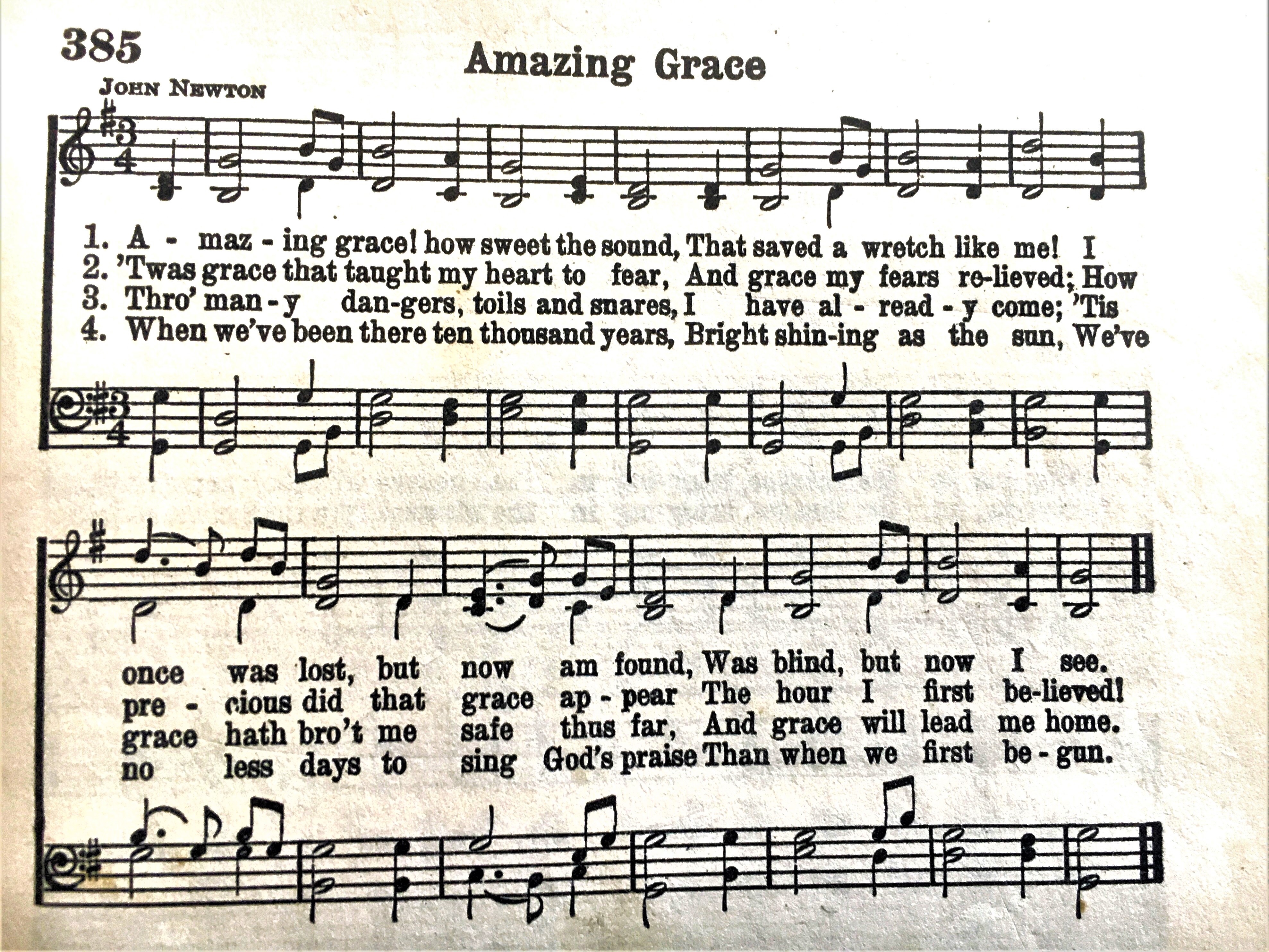
So many have expressed the AMAZING GRACE better than I can! For example, my vintage hymnbook. There is a tender story that goes with my hymnbook, which was a “giveaway”, when a church we attended in Northern Wisconsin purchased new hymnals.
For years my husband, Joe, enjoyed listening when I played the old Gospel hymns on my piano. One day Joe said, “I wish I had a matching hymnbook so I could sing along!”
Well, I went immediately online to Amazon, and found the exact same hymnbook. As I recall, it was all of something like $3.84–and within a few days INSPIRING HYMNS, published by Singspiration, was in Joe’s hands.
Joe put markers on all of his favorites–and we always finished a song session with the classic AMAZING GRACE. Just the name of the hymn gives me goosebumps, and so does the account of its composer, John Newton.
John Newton, 1725-1807, was an Englishman raised by a devout, Bible-believing mother who died of tuberculosis when John was 7 years old. After many rebellious years and harsh circumstances at sea, Newton began a new life as a Christian believer. For a time, he served as a mate and then captain of a slave ship–hoping that as a Christian he could bring something positive to that egregious trade.
Finally John Newton fully realized the abject evil of the slave trade, quit that career, became an abolitionist—and finally an Anglican cleric. He will be remembered forever, as the composer of what is undoubtedly the most beloved Christian hymn of all time.
My husband always insisted on singing all 4 verses of AMAZING GRACE. He especially loved the 4th verse, and Joe was often disgruntled because it is seldom sung. Even in the second-to-none rendition performed by THE IRISH TENORS, whom we loved to stream through our speakers, verse number 4 is missing.
Now my husband Joe is almost 9 months into his 10,000 years—which is not even a dent in our endless ETERNITY with the Lord.
Although many of us do not have the dramatic history of a John Newton, It is absolutely true that “. . . all have sinned and fall short of the glory of God.” Romans 3:23
Our Lord and Savior Jesus Christ Who knew no sin, God in the flesh, willingly gave up His life on a cruel Roman cross to completely absolve us from the sin-debt we could never ourselves pay–thus freeing us from the tyranny of sin and, as we trust and obey, restoring us to endless fellowship with our Holy God.
HE IS RISEN! HE IS ALIVE! HE IS COMING BACK TO REIGN AS KING OF KINGS AND LORD OF LORDS!
Whomever looks to the Risen Messiah Jesus Christ, and trusts in Christ’s finished work at Calvary, is a beneficiary of that AMAZING GRACE. For 10,000 years and forever!
Margaret L. Been — April 3rd, 2021











 Northern Reflections--glimpses of gold by Margaret L. Been